
The dining hall is a much loved and elegant room at the centre of college life despite struggling under the triple burden of woefully oppressive acoustics, crude unimaginative lighting, and inadequate ventilation.
The most significant problem by far is the acoustics. When the hall is full, as it is each week in term time for a formal dinner, with the students excitedly putting the world to rights, the noise in the hall becomes oppressive to the extent that it is impossible to hear what people next to you, or on the opposite side of the table, are saying. Many an embarrassing exchange has resulted from simply having to guess. Convivial evenings are spoilt by unrelenting noise.
The second most significant issue is the outdated lighting, which is incapable of adapting itself to the mood of different functions in the room. The current lighting in the hall leaves a lot to be desired and is based around strip lighting illuminating the barrel ceiling and the daïs. Lighting levels are controlled by switching some of the lights off!
In addition, the hall is home to twelve portraits of previous Principals which are not currently picked out by the lighting scheme.
The hall can be used for many different types of occasions including formal dinners, lectures, receptions and it even lends itself to being a venue for the students’ summer ball once every three years. The college requires a flexible lighting scheme that lends itself to the mood of each such occasion.
The college is seeking an integrated and imaginative solution to the acoustic and lighting inadequacies of its dining hall.
Finally the ventilation is inadequate. Currently the room is ventilated via one extractor fan in the roof void, controlled via a remote switch and speed controller. This is incapable of dealing sufficiently quickly with the rising temperatures when the hall is full.
We are seeking a multi–disciplinary team who can address all of the above issues and develop an attractive and innovative solution which will enhance the existing building and its contents. The outcome of this project should provide a pleasant environment within the hall for events to take place. Removing these obstacles through innovation will allow visitors to fully appreciate the halls architecture and history.
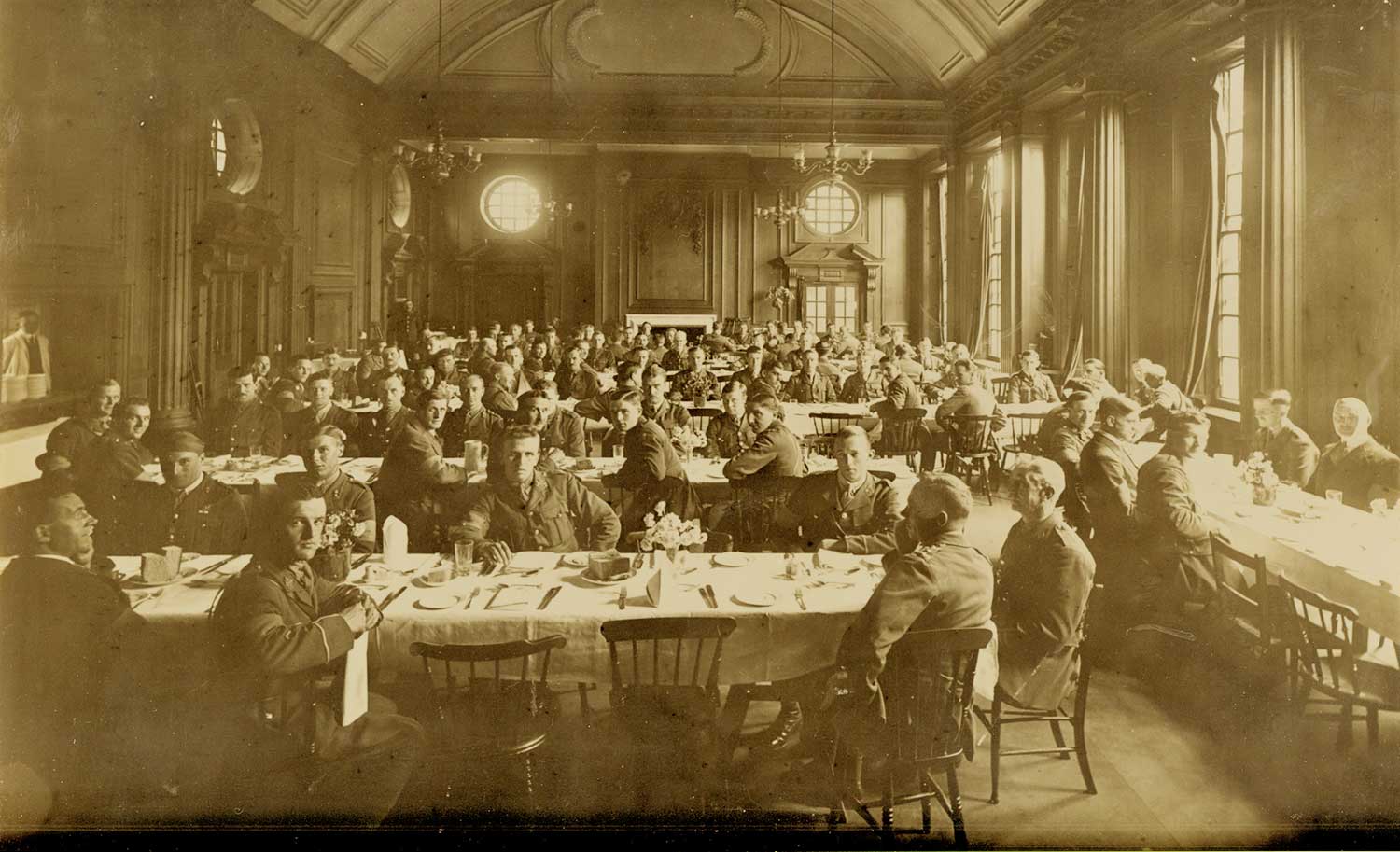
Occupants of the Somerville College dining hall, University of Oxford, have reported experiencing detrimental room acoustic conditions within the dining hall, these have been noted as follows:
Following an initial acoustic assessment, the primary cause of both acoustic issues experienced was judged to be due to the relatively long reverberation time (the time it takes for the sound to decay), in the dining hall. A reduction in the reverberation time by means of the introduction of sound absorptive treatments is therefore anticipated to provide an improvement in the room acoustic conditions.
Baseline acoustic measurements throughout the hall indicate a mean unoccupied mid-frequency reverberation time (Tmf) of 1.55 seconds and a mean Speech Transmission Index (STI) of 0.45–0.5.
The desired target acoustic criteria for the refurbished dining hall in an unoccupied state, has been set at in the region of 0.8 seconds and 0.6 for the Tmf and STI respectively.
As guidance, initial studies have indicated that to gain a noticeable improvement in the room acoustic conditions, at least 100m2 of Class A sound absorptive treatment will be required to be introduced; but, in order to be capable of achieving the desired target criteria, studies indicate that in the order of 170m2 of Class A sound absorptive treatment will be required to be introduced.
The budget to design and install all three elements of the project is £400k plus VAT. This funding is already in place and has been allocated from college funds.
The competition will follow the Invited Design format.
Pre-Qualification via Expression of Interest
Submission of Design concepts in response to an outline brief with accompanying tender return.
Key dates, which may be subject to change, are as follows:
Wednesday 04 March
14:00, Monday 16 March
w/c Monday 23 March
Wednesday 01 April
Monday 06 April
Thursday 09 April
Monday 04 May
Monday 11 May
Monday 01 June
w/c Monday 15 June
Monday 29 June
Wednesday 01 July